
Sovereignty
The theme behind Brexit and ECHR-exit

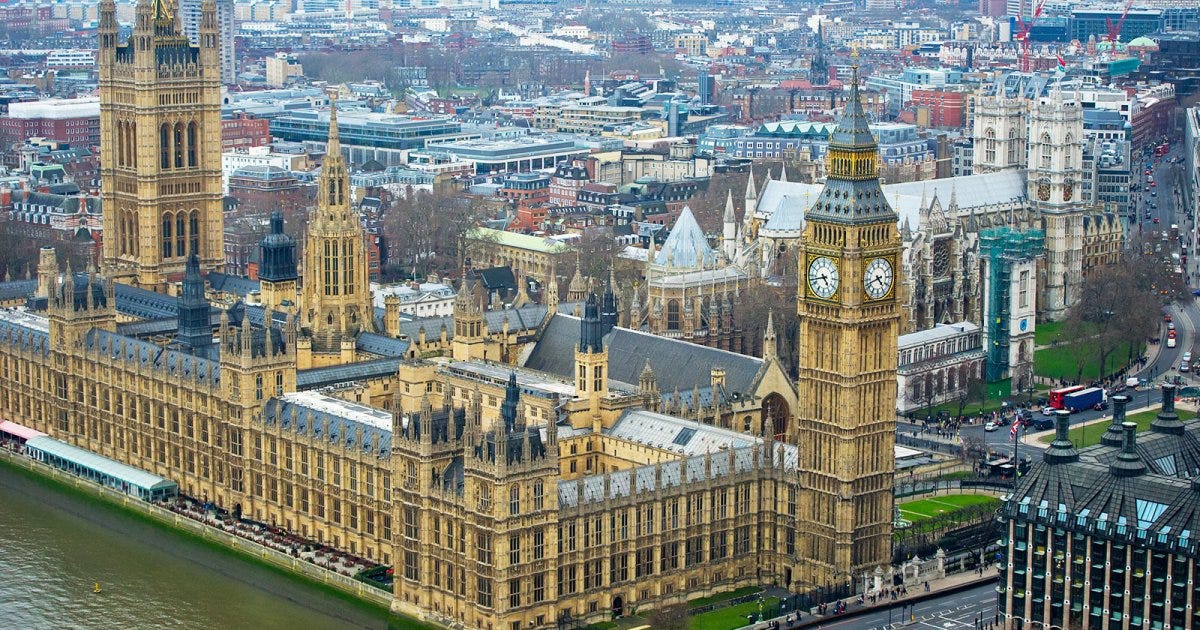
“Under our constitutional dispensation Parliament is sovereign…. it is Parliament which is the highest law-making body and no one—not even the judges—can declare an Act of Parliament, however odious, unlawful.” - Lord Bingham
The definition of what constitutes sovereignty in Britain is a rather straightforward one, as described above by former Master of The Rolls, Lord Bingham. It is that Parliament — or more accurately the ‘King-in-Parliament’ — holds the position of ultimate law-making body for the United Kingdom, a position that cannot be overruled by any other body or person.
If one wanted to break it down further, it is the House of Commons within Parliament that is supreme, not least by virtue of MPs being elected by the British people. The House acts as their voice. The Mace — symbol of ‘the King-in-Parliament’ — consequently rests in the House of Commons whenever the House is sitting.
From time to time, there have been alternative definitions of sovereignty in Britain, but this is not really an issue for the legal sphere, more the political sphere. The most obvious suggestion is that the people are actually ‘sovereign’ because it is they who confer power on the House of Commons. It is not an argument that need detain us long, because while it is true the House of Commons draws its political power from the people, it remains politically and legally sovereign. A parliament that is not sovereign in both political and legal senses, but the people are, would have to regularly refer law-making back to the people, much like Switzerland. The point, therefore, about Parliament being the ultimate legal authority in a constitutional law sense is therefore an important one, and it has the effect, unlike say France or the USA, of not being bound by a supreme written constitution to which law-makers must defer.
Sovereignty was a central theme in the Brexit referendum debate of 2016 and has been a theme over the longer historical arc of euroscepticism running from 1945 to the present day. Brexiters wanted the British — people and Parliament — to be full masters of their own house, much as the definition of British parliamentary sovereignty promises. Put another way, they want the British people to live under laws that only their (British) Parliament has defined and passed. Self-government, in other words.
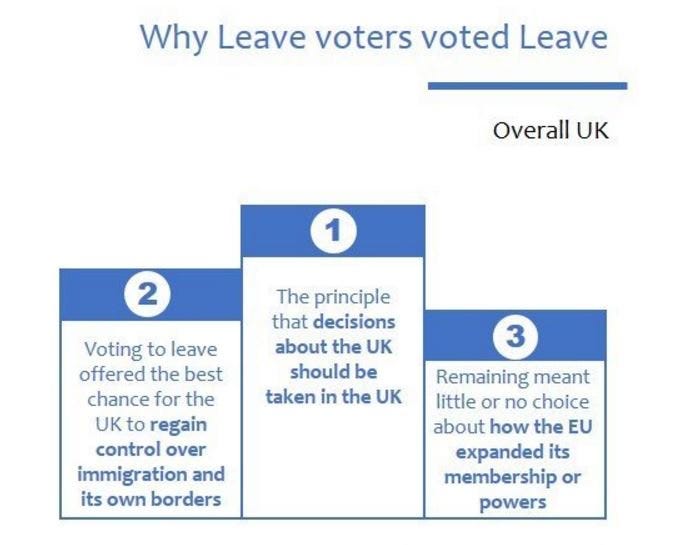
This manifested itself during the 2016 referendum in the famous campaigning phrase ‘Take Back Control’. An Ashcroft poll taken immediately after the referendum vote put this as the top reason for people voting to leave the European Union.
Was sovereignty ever lost?
One can only recover something that has been lost, and the fundamental point of the Brexiter position is that sovereignty was lost through EU membership. More specifically, that ‘pooling’ sovereignty (in the language of Europeans) dilutes and diminishes national sovereignty, and further that qualified majority voting could mean a member state is outvoted and have laws essentially imposed upon them by the others.
Brexiters point to the most obvious example: the case of freedom of movement, in which EU membership necessarily locks a member state into allowing EU migration to take place in the high-principle, treaty-based way that cannot be easily changed or blocked by a member state. In effect, the member states individually have much reduced control over who comes and goes within the EU because (switching to the pro-EU side) that is the beauty of the EU and freedom of movement.
Tim Shipman’s ‘All Out War’ covering the 2016 referendum campaign is instructive on the difficulties freedom of movement caused British politics:
“Another political aide said, ‘The PM always wanted an emergency brake, he wanted to announce that in his immigration speech, but he couldn’t because EU law wouldn’t allow it. We’d go round endlessly in circles and come back to emergency brake. He’d go, ‘We must be able to do something about it!’ We’d always come back to ‘It’s not possible, free movement is a fundamental part of the EU.’ It was frustrating for the PM. He knew what he wanted to do, he knew what the British people wanted’.”
The implication was seemingly obvious: the EU was a source of law that the British people through their representatives in Parliament could do little about. It was thus an offence to the notion of parliamentary sovereignty and to the related longstanding concept that ‘no Parliament can bind its successors’. It was apparently clear that a past Parliament (in 1970-1974) was now binding its present-day successor. EU law had supremacy, or to put more simply, EU law was now supreme over British law and could even strike down British law. For Brexiters, therefore, the reality of EU membership had caused Britain to lose sovereign power and this was continuing on an ongoing and widening basis, as the acquis communautaire (the full body of EU law) only expanded over time.
But there is a problem here. The European Communities Act of 1972 (ECA), which gave legal force to Britain’s EU membership, was an Act of Parliament. And, by definition, it was something that Parliament could repeal if it so chose. What Parliament had made, Parliament could unmake, and it retained the full sovereign power to do so. With the ECA (and subsequent EU treaty amendments given legal force through other Acts of Parliament), Parliament had accepted constraints upon itself by outsourcing a set of competences and law-making powers that could even, in some circumstances, override laws that Parliament then made in other spheres.
Parliament and the British people could, of course, reassert themselves and retake control of these competences from the EU at any time. That, indeed, was what the 2016 referendum was all about.
Sovereignty was therefore never lost during the period of EU membership because Parliament retained the ultimate sovereign power and the UK could legitimately be called a sovereign state. That is what most legal practitioners will tell you and legally they are correct.
However, there is still something not quite right here.
The European Union and EU membership were and are a kind of legal edifice — a large, complex, entangling beast — what is often called a ‘rules-based order’ that was a source of law for the UK (and other member states) by virtue of their membership. Becoming a part of this legal order via Act of Parliament — the ECA — is categorically and sizably different to any other Act of Parliament.
This line of argument came up in the Supreme Court’s judgment on the first Miller case (‘Miller 1’) in 2017, in which Gina Miller and others challenged the government’s proposed use of the royal prerogative because the government, under direct advice from the British people, were essentially pulling the UK out of a treaty obligation using the treaty’s own exit mechanism (triggering Article 50 of the Treaty of Rome). The royal prerogative — the government just deciding a course of action — was proposed by the government because it didn’t require a vote in Parliament and, moreover, international treaties are conventionally subject to that prerogative.
In explaining the Miller judgment handed down by the Supreme Court, Professor Mark Elliott notes:
“The majority [of Supreme Court judges] places great weight on the notion that EU law is a ‘source of UK law’. Indeed, that notion is pivotal to its analysis. The majority concedes that ‘[i]n one sense’ UK law, in the form of the ECA [European Communities Act], ‘is the source of EU law’, because ‘without that Act, EU law would have no domestic status’. However, without repudiating that analysis, the majority declares it inadequately ‘realistic’, and states its preference for the view that ‘it is the institutions of the EU which are the relevant source of [EU] law’. Thus, says the majority, while the ECA ‘gives effect’ to EU law, it is not itself ‘the originating source of that law’. Rather, EU law is ‘an independent and overriding source of domestic law’.”
In this sense, the suggestion is that the EU as a source of law has achieved something akin to independence, despite still being ultimately contingent on the ECA and therefore the UK Parliament.
The Supreme Court also noted the large and complex effects of both joining and leaving the European Union — what was described as constitutional ‘scale’. Professor Elliott again:
“For the majority, that reasoning turns in part upon what might be called constitutional ‘scale’ — that is, the scale of EU membership’s constitutional implications and the (resulting) scale of the implications of withdrawal. The majority says that ‘in constitutional terms the effect of the 1972 Act was unprecedented’, not least because, ‘for the first time in the history of the UK, a dynamic, international source of law was grafted onto, and above, the well-established existing sources of domestic law: Parliament and the courts’. On this view, withdrawal ‘will constitute as significant a constitutional change as that which occurred when EU law was first incorporated in domestic law by the 1972 Act’. It follows, says the majority, that it would be ‘inconsistent with long-standing and fundamental principle for such a far-reaching change to the UK constitutional arrangements to be brought about by ministerial decision or ministerial action alone’. With similar imprecision, we are told that ‘a major change to UK constitutional arrangements can[not] be achieved by a ministers alone’ and must be ‘effected in the only way that the UK constitution recognises, namely by parliamentary legislation’.”
The Supreme Court found for Miller et al and against the government by a majority of eight to three. Parliament then needed to vote on withdrawal; the prerogative was an insufficient means with which to start the process.
Elliott himself sided with the dissenting Justices in the Supreme Court judgment, led by Lord Reed.
“However, whereas the majority sees no tension between this conclusion and its view that EU law is an independent source of UK law, it drives Lord Reed to the opposing view that ‘EU law is not itself an independent source of domestic law, but depends for its effect in domestic law on the 1972 Act’ (my emphasis). The Act gives effect in domestic law to EU law, but the latter is not assimilated to the former, and there has been no change to ‘any fundamental constitutional principle in respect of the identification of sources of law’.
Lord Reed’s analysis of this axiomatic point seems to me compelling, the weakness of the majority’s position being highlighted by the tension barely concealed within it. It is hard to see in what sense the EU’s legislative and constitutional apparatus can be an ‘independent source’ of UK law if the source of EU law’s validity in the UK is itself UK law (in the form of the ECA). The EU regime may be independently capable of generating law — and so be a source of law — viewed from an EU perspective, but it does not follow that the same is true from a UK constitutional perspective, as the Supreme Court itself appeared to acknowledge in the HS2 case.”
I would very humbly suggest that because of the way Brexit subsequently played out, with a wide-ranging impact on UK life, the majority of the Supreme Court got it right. The action to withdraw was of such constitutional scale that disentangling from a source of law operating for the previous 40-odd years really demanded Parliament’s approval to go ahead.
Where does this leave us regarding the question of whether the UK had full sovereignty while it was an EU member state? Lord Reed in Miller 1 clearly held the conventional view that the UK retained sovereignty throughout the period of EU membership by virtue of having control over the ECA. The majority, however, thought it had become more complex than that because of the very nature of the European Union. Despite Gina Miller being seen at the time as an enemy of Leavers, she in fact won a victory that upheld parliamentary sovereignty and, furthermore, got a judgment that suggested it was a not a pure and simple case of the UK never having ‘lost sovereignty’ through its EU membership. While strictly true as per Lord Reed (and many Remainers) that the UK had not lost essential sovereignty, the Supreme Court as a whole clearly saw an additional nuance beyond the argument he put forward.
Leavers really should have celebrated the judgment.
The Kill Switch
Another aspect to the suggestion that the EU was/is a body like no other in its reach and effect on domestic law, is how an EU member state is able to fundamentally amend its relationship with the EU. We are back to David Cameron and his frustration that no change could be made to the EU’s deeply-held principle of freedom of movement. He clearly could not negotiate an emergency brake, which the UK government could pull when politically convenient.
The only way to amend a member state’s fundamental relationship with the EU and its high principles was to leave the EU. If you really can’t play by the club’s rules, you should leave the club.
Indeed, Cameron’s eventual ‘deal’ with the EU announced in February 2016 just before the referendum campaign formally started was considered so limp that he and the Remain campaign never mentioned it again. Politically, he had inadvertently made the case for Leave: that ‘reform was impossible and the only course to effect change was to leave’.
This is the ‘kill switch’ approach to the EU legal edifice — an unnuanced, all-in approach to changing the relationship by simply disabling it in one fell swoop, because amending the relationship with such an edifice — which, let’s not forget, the member state is also a part of — is simply too laborious.
This is what happened in 2016. We forget now, but the organisation that became Vote Leave was rather ambiguous about leaving the EU in the run-up to February 2016. They instead talked the language of reforming the EU, and wanted to wait and see what Cameron managed to win with his eventual ‘deal’. Once the deal was agreed (and immediately kicked into the long grass), Vote Leave only then publicly confirmed that it was time for the kill switch and leave. Negotiation with the edifice had run out of road.
But as the name suggests, the kill switch is dramatic and all-encompassing. And, given the EU’s constitutional ‘scale’, the process of leaving after hitting the kill switch needed very careful handling. This again gives weight to those who suggest the sovereignty position here is more nuanced. If a legal edifice is that hard to leave and the unwinding only comes with a constant threat of serious damage, is it really a parliamentary sovereign power that one would ever want to trigger in any realistic sense? One might of course say, “Yes because it has now been done and Parliament did it”. True, but damage was done. And what if, for example, the UK had also been a member of the euro prior to the 2016 vote? In other words, what is the threshold where, in practice, sovereignty has become so ‘lent’ to the EU and the unwinding so tortuous that in reality it can never be taken back?
A majority of the Supreme Court justices in 2017 could apparently see that the question of exit did impinge on sovereignty, and that the constitutional scale involved in exit was very high, perhaps unbearably high.
Ever Purer Sovereignty
It was always likely that a new legal order would need to be in place between the EU and UK after exit, perhaps borrowing from some of the old order (e.g. an EEA relationship) or some other off-the-shelf set of legal arrangements (e.g. a Turkish-style customs union). But that itself would require some sovereignty considerations — the UK was not going to just ‘get our country back’. This of course sent the Brexit camp into a cycle of wanting ever purer sovereignty, leading to calls for ‘No Deal’ — the ultimate sovereigntist end-point and also the ultimate isolationist calamity that would put Britain at the mercy of regional and global forces well beyond her control.
Full sovereignty in the modern world was thus revealed, in practice, as an illusion — a cul-de-sac, which only a 180-degree U-turn could pull you out of. ‘Take back control’, it was not.
Which brings us back to how sovereignty should be viewed in the modern world and particularly against the backdrop of the unavoidable existence of the EU on Britain’s doorstep. The answer can only really be to engage fully with the EU, whether Britain likes it or not. And given Britain’s long history of independence without fascism, Britain engages begrudgingly. The ever-awkward partner.
Nonetheless, there appears to be little by way of an alternative — what former Prime Minister Harold MacMillan once called Britain’s ‘grim choice’.
In the wake of Brexit, Britain and the EU created a new, albeit much smaller legal edifice with the EU in the form of the Trade and Cooperation Agreement (TCA) that provides some benefits and requires some corresponding obligations. Brexiters hate the obligation element and so grumble about the deal. They still haven’t learned that there is no other way short of the chimera of ‘splendid isolation’.
So Britain did land on the TCA as the new governing legal relationship, but it could have easily failed even to do that. The ‘No Deal’ scenario came close to playing out but it was Parliament and the Supreme Court (in the form of ‘Miller 2’) that helped draw the country and the government back from the brink.
The problem with having an impulse to tear down a legal edifice hardly inclines one to create a new one. At its worst, it is the mindset of barbarians at the gate finally breaking through and suddenly expecting to be civil. Or the dog that caught the bus. It is not a position that naturally lends itself to statecraft, and so it proved.
This is why simplistic dabblers in sovereignty risk serious damage. They don’t know where to stop in their quest for ever purer sovereignty.
Sovereignty, Human Rights and the ECHR
This brings us to Brexiters’ new target: the European Convention on Human Rights (ECHR) and the domestic legal instrument of the Human Rights Acts 1998 (HRA), which gives the ECHR direct effect in our own courts.
Like the EU, the ECHR is seen as a mechanism (via the European Court of Human Rights in Strasbourg) that overrules parliamentary sovereignty with ‘rule by judges’.
The HRA is a relatively recent piece of legislation and it is within Parliament’s power to repeal it. This would not however represent a ‘kill switch’ in the same way as repealing the ECA, because Britain would still be a signatory to the ECHR and still be subject to the Strasbourg Court. It is therefore this relationship that Brexiters are really gunning for.
ECHR-exit is a whole topic in its own right, and I’ve written a little about it here.
There are however parallels with exiting the EU, and also some parallel players involved in the argument. Once again Brexiters want Britain to see Parliament totally define and be able to re-define what human rights legally mean here. But as with Brexit, no ‘splendid isolation’ is possible in practice, not least because ECHR-exit would immediately impact the Good Friday Agreement for Northern Ireland and also the TCA with the EU. The EU would use its political and economic muscle to ‘keep Britain honest’ on human rights. With ECHR-exit, we are again staring down a political cul-de-sac.
One of the more thoughtful voices calling for ECHR-exit is Lord Jonathan Sumption, a former Supreme Court judge. He calls for ECHR-exit and for the repeal of the HRA because he sees that the ECHR is a living instrument straying into areas that he believes should be the normal and sole preserve of democratic debate i.e. Parliament. But he also suggests that Parliament would very likely want to recreate the ECHR/HRA in pure domestic form after ECHR-exit such that it can be amended from time to time.
In other words, a legal edifice would be replaced by another (domestic) legal edifice.
But this doesn’t learn the lessons of Brexit, which is that those demanding their sovereignty back do not want another legal edifice. Such people also radicalise along the way, demanding ever purer sovereignty. Lord Sumption therefore strikes me as the Liberal Leaver of the ECHR-exit debate: a thinking figure who will nonetheless get trampled by his own side at the first opportunity. And that’s also because ECHR-exit provides Brexiters with the opportunity for the No Deal Brexit they still wish for, via the tearing up of the TCA and its ECHR clause.
The Sumption approach therefore strikes me as logical but politically naïve.
Particular problems with Britain’s Parliament
One can’t write about British parliamentary sovereignty without touching on the particular problems associated with its workings. It may be considered the ‘mother of all parliaments’ but it is not a kind of glittering purity to which other democratic countries aspire.
On this point, I can thoroughly recommend Ian Dunt’s book on ‘How Westminster works and why it doesn’t’.
But in summary, Britain’s First-Past-The-Post (FPTP) voting system does not create Parliaments that are reflective of the people’s will. Indeed, FPTP is not meant to — its primary purpose is to create governments that have majorities and are therefore stable. There is a democratic connection between governments and the largest group of voters wanting that government, but not to a majority of voters. In fact, no party has received a majority of votes since 1931, when the Conservative Party received 55% of the votes. Nothing can therefore be said to be truly done in the people’s name.
There is also a problem with the power of the Executive in Parliament, which can be overwhelming. Governments with good majorities effectively have ‘carte blanche’ to do what they like, within reason, and conventionally — but only conventionally — within the constraints of their election manifesto.
That brings us to Britain’s ‘good chaps’ theory of government which relies on those elected into government being ‘good chaps’ and observing established conventions. Arguably, Britain is exposed, even more so than the constitution-based United States, to the possibility of a convention-breaking, autocratic/fascistic government.
Britain’s Parliament also suffers from outdated and sometimes pointless mechanisms for debating and amending proposed legislation. Bad law is at an ever-constant risk of being made. And is made.
Furthermore, there is the issue of delegated legislation and so-called Henry VIII powers which the government increasingly uses to bypass parliamentary scrutiny and to get law onto the statute books quickly. It became more necessary to use delegated legislation during and after Brexit in order to make sweeping changes across the entire statute book, so ironically, one might say Brexit caused parliamentary sovereignty to be bypassed/neutered.
Britain has never been through a revolutionary update of its constitutional and democratic arrangements because it has never had to. It was, after all, never overrun by fascism/totalitarianism unlike most of its European partners — a big factor in why Britain thinks differently about Europe.
The problem is that this lack of renewal now really shows. The Palace of Westminster’s increasing problems with the physical building seem a fitting metaphor for the state of Britain’s democracy and its Parliament.
Maybe it is time to move on, in every sense.
People Like Us
In concluding this piece, we need to consider how sovereignty is seen on an emotional level. Why? Because that’s where it is mostly argued by Brexiters. It is not, for them, a dry legal construction.
For Brexiters — and I’m sure many others, but particularly Brexiters — sovereignty rests on an emotional bond between the ultimate sovereign power (Parliament) and the people from whom its power is drawn, and for whom the sovereign power shapes the legal and constitutional landscape.
This is the bond between government and governed — the thing that holds us together as a recognisable nation of people, even when our government does not go the way we would prefer. It is about who we mean by ‘we’ and ‘our’.
This is the ‘demos’ point often made by Brexiters, where, it is suggested, a nation state holds together and has a level of legal control over its people because of the shared bonds that make up those people — shared bonds of history, culture, custom, habits, symbols, geography, and perhaps additionally (but not always) language.
The Brexiter view of sovereignty rests heavily on the notion of a demos and, more simply put, of ‘people like us’. There is an obvious crossover here into Brexiters’ objections to immigration and also of the racism impulse that is too often found woven into this side of politics.
The crux of the matter vis-à-vis the EU is that Brexiters do not see Europeans as ‘people like us’, while Remainers/Rejoiners do. It is why the latter group sees resolution of the so-called ‘demos problem’ in simply having a European Parliament and deepening the demos through that over time. For Brexiters, such a parliament is akin to a random group of disconnected people voting on random things. In extremis, they see it as like trying to created a parliament among all countries starting with the letter M — a concocted and ultimately meaningless construct with no emotional or moral right to create laws for the people in those ‘M countries’.
For Brexiters, this may not be necessarily true of the bonds that may exist among other European countries, but they see Britain as the exception, with history looming very large — especially Britain’s long history of independence and democracy, with World War II playing a particular role.
Conversely, Brexiters are more relaxed about making binding arrangements with countries that, as they see it, do represent ‘people like us’. So Australia, New Zealand, Canada, and the USA, sometimes dubbed (selectively) ‘The Anglosphere’. These are all seen as ‘people like us’; ‘cousins’ even. The vast majority of emigrants from Britain move to these countries, apparently reinforcing the idea that they are a more natural ‘fit’ for the British than Europe is.
This explains why there have been, with no apparent irony, Brexiter calls for freedom of movement arrangements with these countries.
And yet we are clearly no longer talking about sovereignty in the same way as discussed in the context of Europe, but about what Brexiters would see as a kind of extended ‘demos-lite’ across these countries that somehow then permits sovereignty to be pooled. The apparent desperation and assumption about a rapidly-forthcoming trade deal with the USA post-Brexit was grounded in the same demos-lite thinking.
The Anglosphere freedom of movement idea is actually a rather attractive one and could potentially be progressed, especially if we were sure of our destiny outside Europe. But we are not. ‘Geography is destiny’, and while that may drive the insular Brexit impulse — a separated island off the coast of Europe — it also presents the UK with something of a hurdle when considering deep arrangements with far-away countries with whom we trade much less. It’s why Brexiters try to stress that geography has become irrelevant in the modern world (it hasn’t), and even, incredibly, why Britain is a geographic gateway to the Pacific.
The Anglosphere idea has since been rather overtaken by events, particularly the politics of the USA and the Trump presidency. It has become starkly apparent for both British and Canadians in particular, that Americans no longer seem like ‘people like us’, and any Brexiter suggestions of a post-Brexit future between Canada-Australia-New Zealand-UK (‘CANZUK’) always rested on the notion of a strong, stable and supportive America in the background. That has been blown away by the Trump presidency, possibly forever, and Canada (threatened directly by Trump’s America) is already making friendly overtures towards the EU.
Brexit Britain appears to be cast adrift, dependent in security terms on America and yet emotionally (increasingly) we are again fellow travellers with the Europeans.
It turns out that a sovereign Britain making its way in the world out on the open seas is a rather rough and dangerous place to be.
Indeed, Brexit has arguably become a textbook case for how to make a mess of sovereignty in the modern world. And it’s why other member states have not followed us out.
Great essay. What escaped brexit voters... if not proposers... was that our sovereignty is predicated upon our ability to project power and the lenses through which it is magnified. Our influence in Washington or Beijing or bloody anywhere was directly connected to our place at particular tables. But our soft power was trampled beneath the yearning for alpha male belligerence... our diplomatic clout strangled by nationalism... the shared empire of previous colonials and its global vestiges were abandoned for dumb entitlement... and Putin laughed and MAGA populism got the royal assent... as Commonwealth graves were abandoned by global Brits.
This was an interesting essay - thanks!
One thing not discussed that I'd like to see added if you ever redo it - why didn't Cameron attempt to get Parliament to pull his "emergency brake" unilaterally? My assumption is that he didn't because he believed that the risk of the EU excluding us from parts of the benefits of membership was higher than the risk of not pulling the emergency brake, and thus that "leaving the EU to recover this sovereignty" was the wrong thing for people to take away from Cameron's failure to pull the emergency brake.